On October 12th, CFF partnered with The Martha and Hunter Grubb foundation to host a briefing titled, Scaling Regenerative Agriculture in the Northeast.
The session started with an overview of regenerative agriculture and all that the term entails, to provide a framework for the rest of the discussion. While no legal or regulatory definition exists, all of the speakers agreed that regenerative agriculture must encompass more than just the practices that promote soil health and climate benefits, and include impacts on the people involved as well. Our working definition for the session comes from the Regenerative Agriculture Alliance (emphasis added):
A regenerative agriculture system delivers soil health, carbon sequestration, improved water cycles and an endless list of other ecological regeneration benefits. It also incorporates a vast array of practices, such as cover crops, no-till, reduced tillage, agroforestry, etc. When implemented and adapted to the needs of the ecosystem, these practices lead to outcomes that support ecological, social, economic, and spiritual regeneration. Fundamentally, regenerative agriculture starts by evaluating the original ecological blueprint of a region and then designing a process by which food, fiber, and other outputs can be generated while restoring the original ecology of a region.
We also recognized that these principles and practices are not new at all, but come from indigenous cultures who were stewards of the land for centuries. In fact, if native people were not forcibly removed from the land, we likely wouldn’t need to have conversations like this or be in this dire predicament.
After the opening framing, we heard from several practitioners in the northeast working to implement and expand regenerative agriculture in our region.
The slides from each presentation are visible in the video below, but you can also download the slides shared from Glynwood, Scenic Hudson, and Zero Foodprint here, as well as the speaker bios. See below for additional resources mentioned and shared as part of this meeting.
The following time markers can be used to jump around to different sections of the video:
- Start – Welcome and intro by Adam Liebowitz, CFF Director
- 4:50 – Laura Lengnick, Glynwood Center for Regional Food and Farming
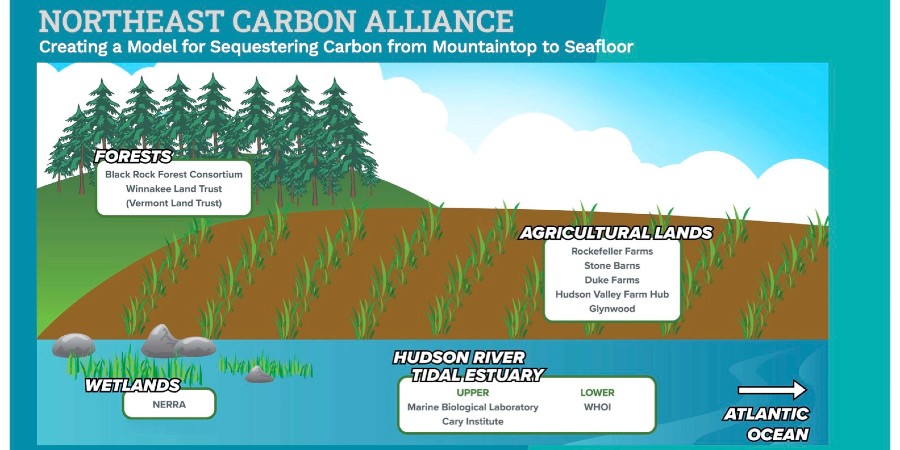
- 15:50 – Ned Sullivan, Scenic Hudson & Northeast Carbon Alliance
- 28:40 – Ben Dobson, Hudson Carbon
- 41:35 – D Rooney, Rock Steady Farm
- 52:50 – Anthony Myint, Zero Foodprint
- 1:07:30 – Q&A
“Let’s regenerate our heart’s ability to have a different relationship with our farming practices, and also uplift those farmers and growers that are out there every day“
– D Rooney
Additional Resources
Readings shared in advance
- What is Regenerative Agriculture (FoodPrint, 2021)
- Regenerative Agriculture Needs a Reckoning (The Counter, 2021)
- What is Regenerative Agriculture: A Review of Scholar and Practitioner Definitions Based on Process and Outcomes (Frontiers in Sustainable Food Systems, 2020)
- Native Growers Decolonize Regenerative Agriculture (Green America, 2020)
- Does Regenerative Agriculture Have a Race Problem? (Civil Eats, 2021)
- How Returning Lands to Native Tribes Is Helping Protect Nature (Yale Environment 360, 2021)
Citations from Laura’s presentation
- Ranking of Top 20 Most Cost Effective Climate Solutions from Drawdown 2019: Drawdown.org and Farming Our Way Out of the Climate Crisis (Project Drawdown, 2020)
- Mitigation Potential of Sustainable Agriculture Infographic data from Climate Solutions in California Agriculture (California Climate & Agriculture Network, 2014)
- Barriers to adoption of regenerative agriculture practices from Catalytic Capital and Agriculture (Environmental Defense Fund, 2020)
- Estimate of unfunded USDA conservation practice applications from Agricultural Conservation: A Guide to Programs (Congressional Research Service, 2020)
Links/comments from the Zoom chat
- Documentary film: Kiss The Ground (2020)
- This report also speaks towards the highest possible estimate of the opportunity: Regenerative Organic Agriculture and the Soil Carbon Solution (Rodale Institute, 2020)
- A great film that addresses what Ben and D are speaking about – the roots of Big Ag – watch: Look and See: A Portrait of Wendell Berry (2016)
- CFF webinar with Black Farmer Fund and Northeast Farmers of Color Land Trust (2020)